

Marstall
Sources from the early 18th century tell us that between 1710 and 1715 a stable was built to the south of the cour d'honneur, at an angle to the palace building. The complex is said to have been dilapidated as early as 1759, but was not demolished until 1761. At the same time, Nicolas de Pigage submitted a concept for a new stables in 1752.
The Electoral Palatine Generalissimo, Prince Friedrich of Palatinate-Zweibrücken (1724-1767), had a stable built on today's Carl-Theodor-Strasse in 1750/52. Friedrich Michael had been Electoral Palatine Field Marshal and Governor of Mannheim since February 1746. He was considered one of the best-looking men of his time and is said to have been at times one of the lovers of his sister-in-law, Electress Elisabeth Auguste.
Initially, the part of the Marstall facing Carl-Theodor-Straße was built. The stable was flanked by two-and-a-half-storey pavilions. Living quarters were installed here, whereas the mezzanine floors were divided into chambers. In a second construction phase, a coach house was built adjacent to the side.
After it was decided in 1754 not to pursue the plans for the Marstall at the palace any further, Elector Carl Theodor purchased the building complex in 1759 for 30,000 gulden and had it extended by court architect Wilhelm Rabaliatti. The Elector's Marstall is one of the most important Baroque buildings in Schwetzingen.
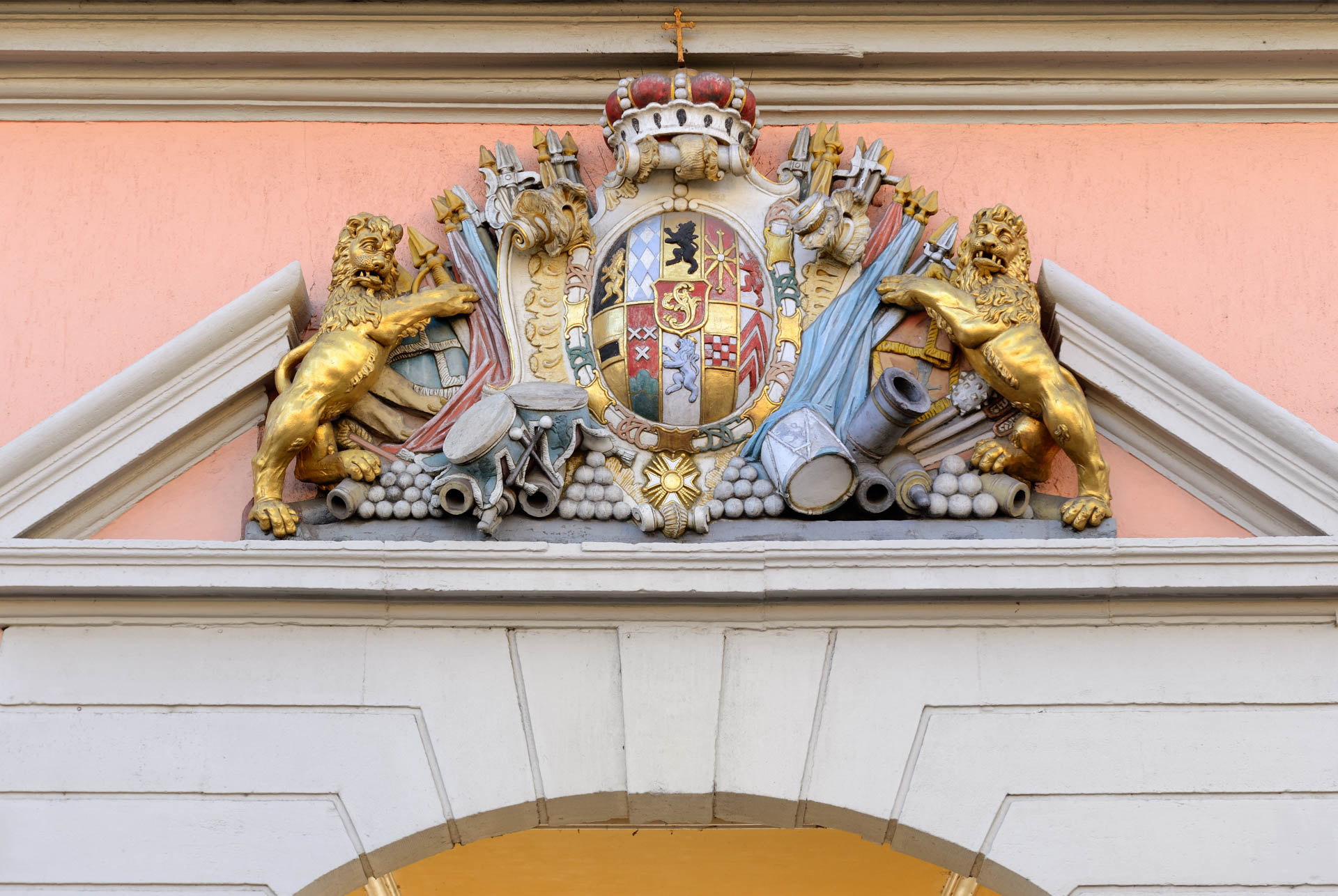
As the Elector was the supreme warlord at the time when the Marstall was built, the Electoral coat of arms was placed above the doorways. It is one of the most beautiful and largest surviving coats of arms of the Electorate. It is not known who made and designed the coat of arms. The building was also subsequently used for mounted troops until 1918. After a fire in 1924, it was rebuilt and from then on housed shops and private flats. At the end of 2021, an urban gardening project was initiated in the inner courtyard, supplemented by four motif benches that refer to special personalities in the history of science.