

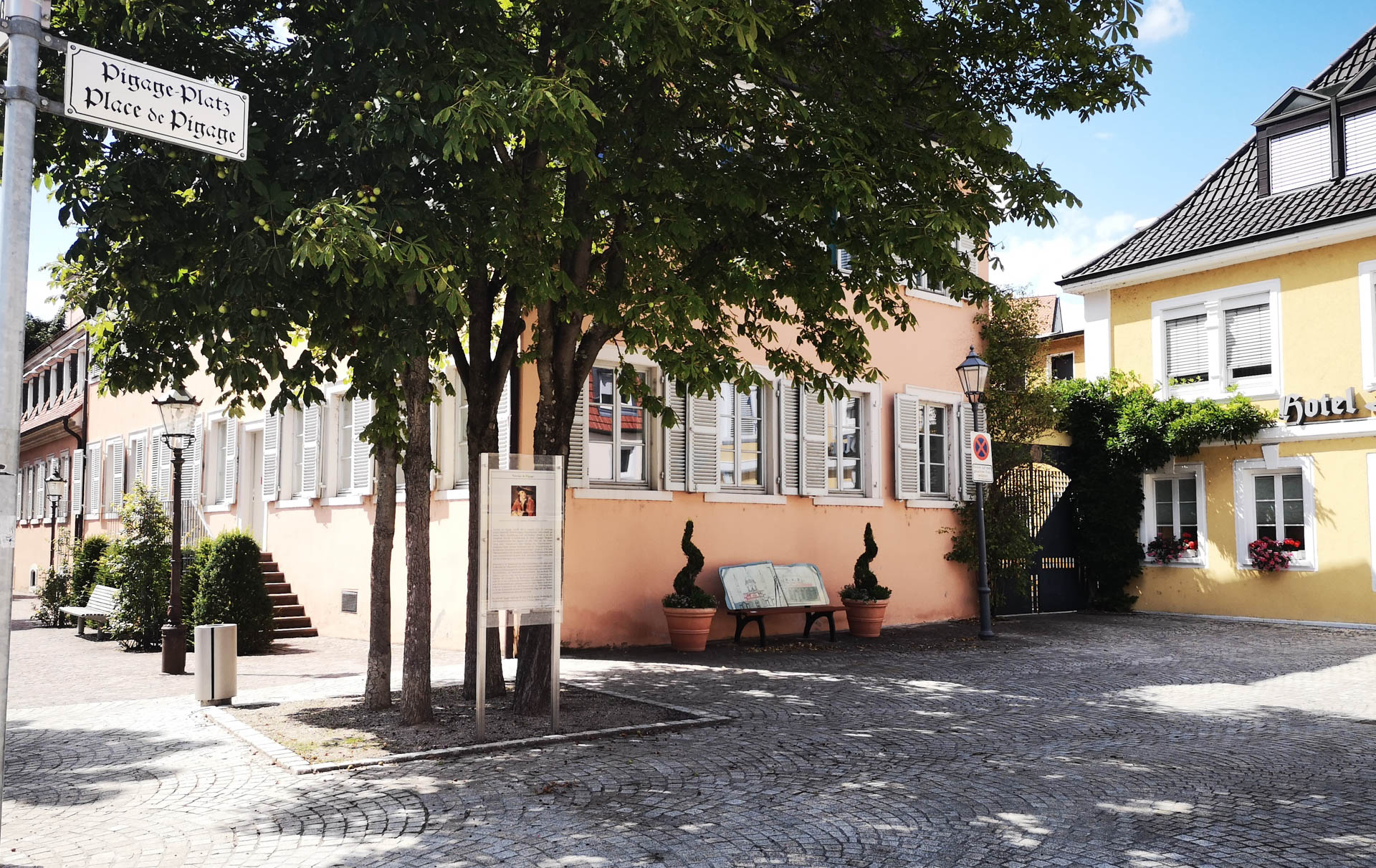
Pigage Square
Born in Lorraine, Nicolas de Pigage studied at the Académie Royale d'Architecture in Paris. After stays in England, Italy and the Netherlands, Pigage returned to his home town of Lunéville. On recommendation, he came to the Electoral Palatinate Court in 1749 as "Intendant dero Gärthen und Wasserkünste".
In Schwetzingen, the "Oberbaudirektor" made a name for himself in 1752 with the construction of the palace theatre in the northern circle building. In 1762, the title and function of "garden director" followed. Pigage now began to expand and design the Schwetzingen Palace garden. All of Pigage's garden architecture has been preserved in its original form to this day. With the bathhouse, the creation of the basin of the water-spouting birds and the "Pavillon d'optique", popularly known as the "end of the world", Pigage created true gems in the palace garden.
Nicolas de Pigage succeeded in creating a fascinating combination of the Schwetzingen Palace Garden. Pigage extended the Baroque section with the New Orangery, the Natural Theatre with the Temple of Apollo and the Minerva Temple. He extended the middle parterre beyond the Hirschbassin to the Großer Bassin. With the Temple of Botany, the Roman Water Fort, the Mosque and the Temple of Mercury, Pigage set refined accents in the landscape garden of Friedrich Ludwig von Sckell.
Pigage died in Schwetzingen in 1796 and was buried in the old cemetery. After the cemetery was dissolved in 1870, however, his remains were not moved to the new cemetery. Nor was a grave of honour created on the original site, as was initiated for Johann Peter Hebel. To counteract this omission, this small square was renamed Pigageplatz a few years ago, and an information board and a motif bench were placed in his honour. Next to it, a bust will permanently commemorate the great garden architect at the Platz der Freundschaft from 2022. Incidentally, because of the Frenchman in Schwetzingen, a town twinning between Schwetzingen and his native town of Lunéville was established in 1969.