

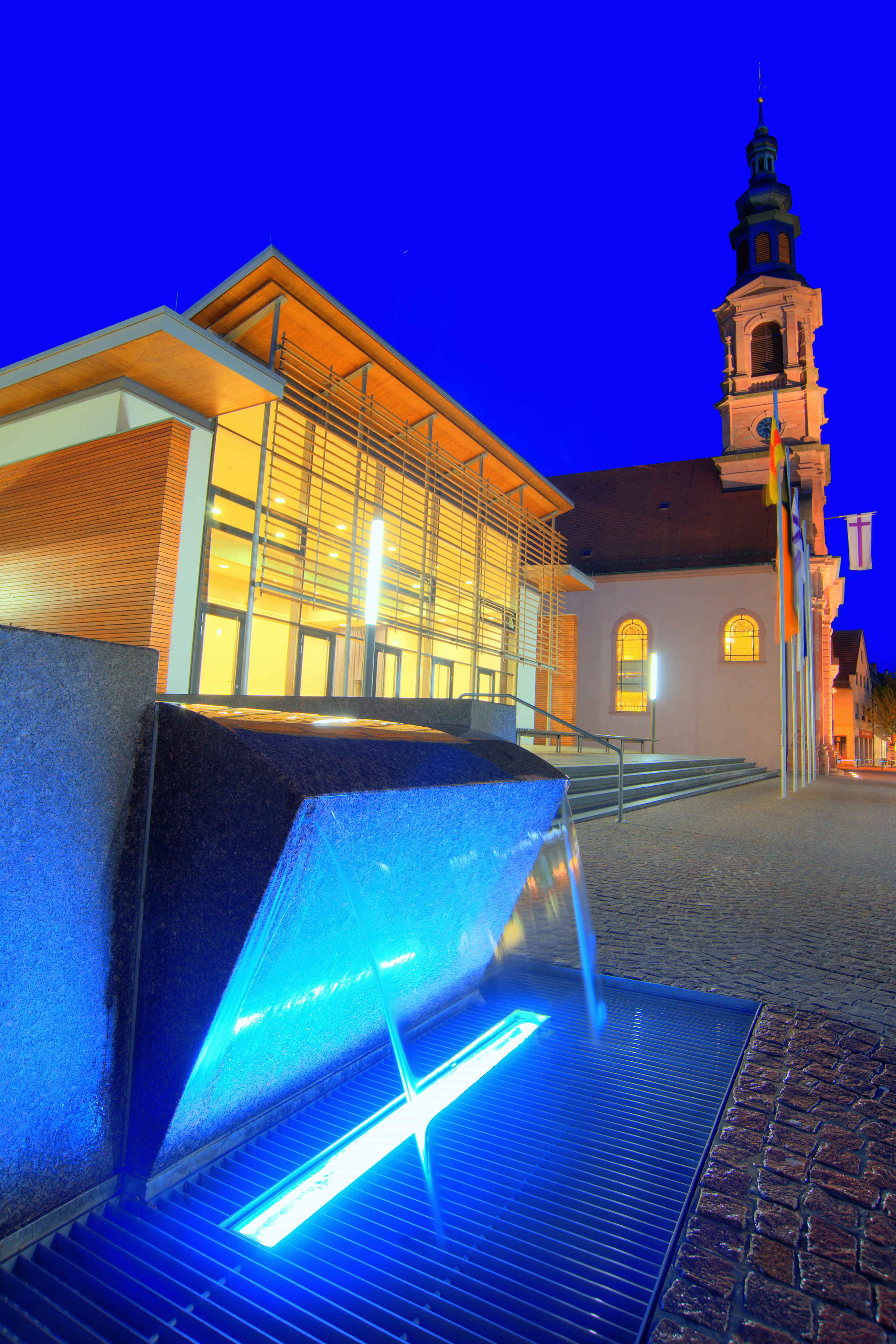
Evangelische Stadtkirche
In 1705, the Catholics of Schwetzingen were again given sole use of their church of St. Pancratius with the Declaration of Religion under Elector Johann Wilhelm, after it had been used as a simultaneous church by both denominations between 1698 and 1703.
Now it was time to build a Protestant church in Schwetzingen as well. At the request of Elector Johann Wilhelm, the Reformed Church bought a plot of land on which the first wooden church building was erected in 1723. After this building had to be torn down because it was dilapidated, another petition to build a stone church was submitted, this time to Elector Carl Theodor in 1753, which was granted immediately. The Protestant Town Church was completed in 1760, at a time when Schwetzingen was already the Elector's summer residence and had been elevated to the status of a market town.
The Protestant Town Church was extended and rebuilt from 1884-88. Due to dilapidation, Hermann Behagel was called in to extend and redesign the tower in 1912-13. The tower has a slender and towering design, is equipped with tower clocks similar to the castle façade and is crowned with an elaborate gilded tower cross.
To support the approx. 40 m high tower, a number of measures had to be taken to strengthen the statics, which probably did not result in any serious changes to the appearance. Only speculations can be made about the appearance of the former façade, but it can be assumed that the basic features of the façade follow those of the Carl Theodor period, especially since a neo-baroque style was rather unusual for church buildings at the turn of the 19th/20th century.
The interior of the room, with its crowded chancel arch, the triptych of Art Nouveau stained glass windows in the chancel and the Neo-Renaissance stained glass windows on the side walls with portraits of the Reformers Martin Luther and Philipp Melanchthon, is a clear reference to the period in which it was built, 1912-13.