

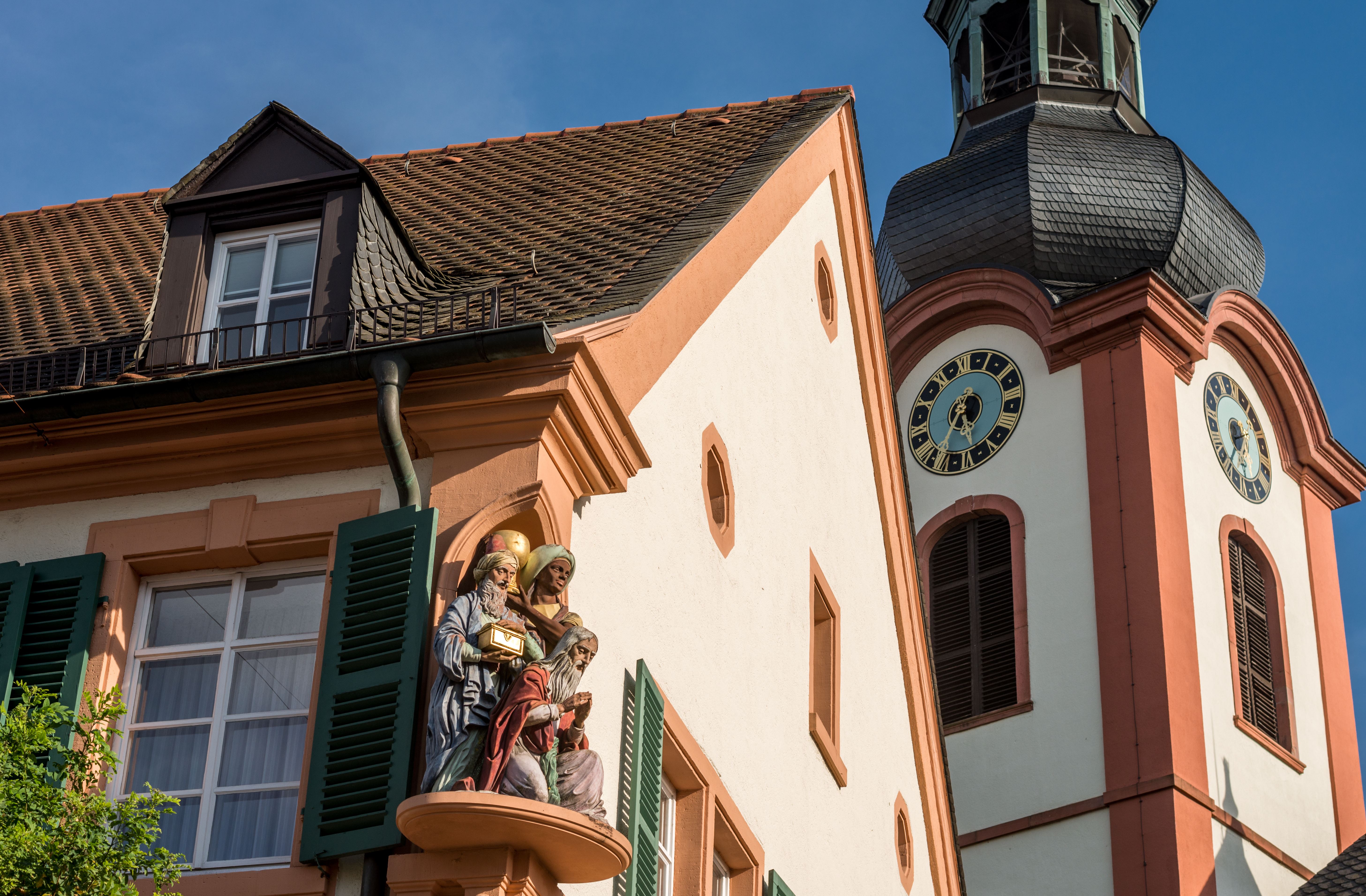
St. Pancras Catholic Parish Church
St. Pankratius is the oldest church in Schwetzingen. A foundation building is mentioned in 1305, and the church patronage of St. Pankratius is attested for the year 1435. In 1484, the consecration of the side altars of St. Nicholas and St. Catherine took place. There are no longer any clues as to the appearance of the church at that time.
St. Pancras was exposed to the turbulent religious history of the Electoral Palatinate, with changes of religion taking place under each of eight electors. The church was destroyed in the turmoil of the Thirty Years' War. With the return of Elector Carl Ludwig (1649), a church was built which was damaged again in the Palatine-Orléan War at the end of the 17th century. A "reparation" took place in 1699, shortly before Elector Johann Wilhelm came to Schwetzingen from Düsseldorf. The church was used as a simultaneous church for a time.
After a huge increase in the Catholic congregation, which was able to use St. Pancratius on its own again from 1705, Sigismund Zeller was commissioned in 1736 to design a new building, with the request that the tower be retained. In 1739, the consecration could take place by Auxiliary Bishop Baron von Merle from Worms. Soon after, a new construction of the tower became necessary, and the demolition took place promptly. The new building was actually not completed until 1755 according to plans by the court architect Franz Wilhelm Rabaliatti. Further damage necessitated a new façade design in the early classicist style according to Rabaliatti's designs.
The building was also extended towards the west according to plans by the court architects Sigismund Zeller and Nicolas de Pigage. The style of the building is based on the palace buildings, although St. Pancras was not a court church. While the exterior was created in a rather restrained manner, the interior with its Baroque high altar, sculptures and paintings unfolds a multifaceted artistic splendour. The high altar is designed in the sense of a "theatrum sacrum". Particularly impressive are the two angel figures, said to be by court sculptor Paul Egell. In the outer area, near the Pigageplatz, is the figure of St. Nepomuk, whose creation can be assumed to be in Egell's circle - perhaps even by the master's hand. In contrast, the depiction of the Mother of God with the Child Jesus in the outer area of St. Pancras can be stylistically assigned to the environment of the court sculptor and successor of Paul Egell, Peter Anton von Verschaffelt.