

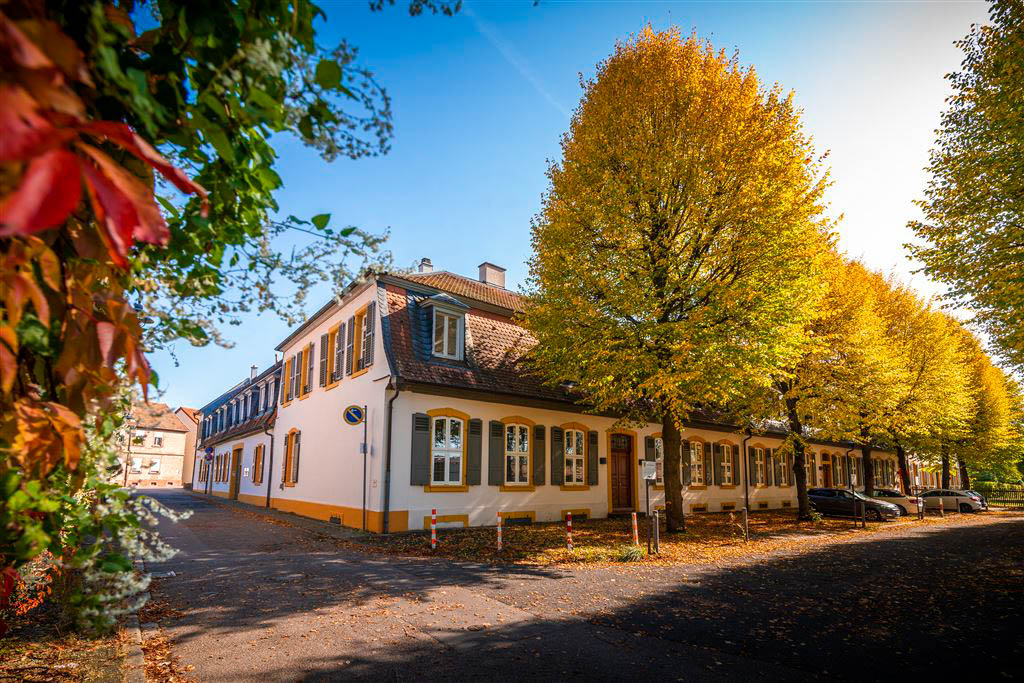
Ysenburg Palace
Das Ysenburg´sche Palais wurde 1760 nach Plänen des Hofbaumeisters Franz Wilhelm Rabaliatti erbaut, und von Angehörigen des kurfürstlichen Hofstaates, wie z.B. Oberhofgärtner von Wynder, bewohnt.
Count Friedrich Wilhelm von Ysenburg-Birstein, who was married to Caroline Countess von Parckstein, an illegitimate daughter of Elector Carl Theodor and the dancer Françoise Desprès-Verneuil, also lived on the estate as master of the hunt. During this time, several extensions were built in 1775.
In 1778, Ysenburg and his court moved to Munich, after which his successor, Count von Waldkirch, lived here. The ensemble changed occupants several more times until Gustav Bassermann and his wife Clementine acquired it in 1864. The couple belonged to the Mannheim banking family.
The building is characterised by a simple early classicist exterior, whereas inside a magnificent staircase still bears witness to the former aristocratic inhabitants. The row of buildings ends in the present-day Baden Forestry Office.
The building, which was called a hunting lodge in the 18th century, is also attributed to Wilhelm Rabaliatti due to its stylistic proximity and the interior design. Friedrich Heinrich Georg Freiherr von Drais (1803-07), who from 1804 onwards established an arboretum in the palace garden with garden director Johann Michael Zeyher, lived and worked here. In addition, he ran a private forestry master school, where his nephew Karl (Freiherr von) Drais taught from 1805-07.
Legendary is the first ride of Karl Drais' running machine, which was supposed to lead from Mannheim Castle to Schwetzingen Castle on 12 June 1817. For unknown reasons, the journey ended prematurely at the relay house in what is now Mannheim-Rheinau. Fortunately, this was in the Schwetzingen district at the time, so that Schwetzingen can still advertise the first historic ride.